
Sundarbans.. Walking Into the Lungs of the Earth
The World’s Largest Mangrove Forest | Sundarbans, Bangladesh
There is a forest that doesn’t want you to find it easy.
No dramatic mountain gates, no sweeping valley approaches, no moment where you crest a ridge and suddenly see it. The Sundarbans arrives quietly — a thickening of the air, a deepening green at the waterline, the gradual disappearance of the world you came from. One moment you’re on a boat on the Pasur River. The next, the forest has simply absorbed the horizon.
This is how the Sundarbans works. On its own terms, in its own time.
Arriving by Water
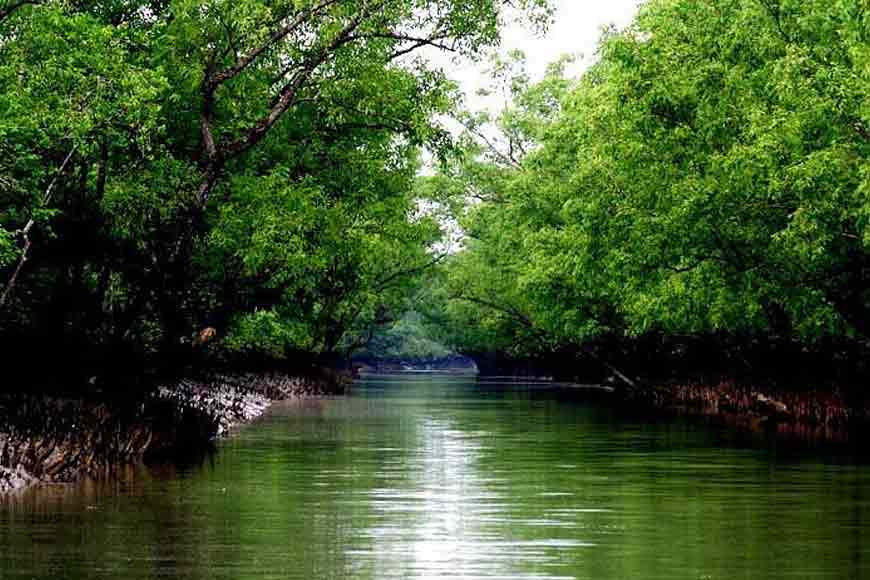
There is no other way. The Sundarbans — spanning roughly 10,000 square kilometres across Bangladesh and India, the world’s largest mangrove forest and a UNESCO World Heritage Site — is accessible only by water. Its trails are tidal creeks, its roads are rivers, its landmarks are trees that breathe through roots.
I came in by launch from Mongla, the port town in Bagerhat district that serves as the southern gateway. As the boat moved deeper into the delta, the Sundarbans announced itself in stages. First, the water changed colour — from the muddy brown of the Pasur to something darker, tannin-stained, the colour of strong tea. Then the trees appeared at the water’s edge: the sundari trees (Heritiera fomes, the forest’s namesake), their stilt-like roots reaching into the mud like careful, deliberate fingers.
By the time we reached Karamjal — the forest department’s wildlife centre near the entry point — the outside world felt genuinely far away.
The Mangrove Architecture
Nothing prepares you for the strangeness of mangrove forest at close range.
It is beautiful in a way that takes adjustment. No grand canopy, no cathedral light filtering through lofty branches. Instead, the Sundarbans offers a denser, more intimate beauty — a tangle of pneumatophores (those extraordinary breathing roots that spike up from the mud like a field of pencils), the overlapping arches of prop roots, the dark water threading between tree trunks that seem to float.
The forest floor
if you can call the muddy, rooted, tidal terrain a floor — is not easily walked. This is not a hike in the conventional sense. You move on narrow embankments, on wooden boardwalks where they exist, on the hulls of small boats between tidal creeks. You are always aware that the ground beneath you is provisional, that the tide has opinions, that this landscape belongs first to the ecosystem and only very temporarily to you.
This is not a place that tolerates carelessness. It rewards attention.
The Tiger Beneath the Surface
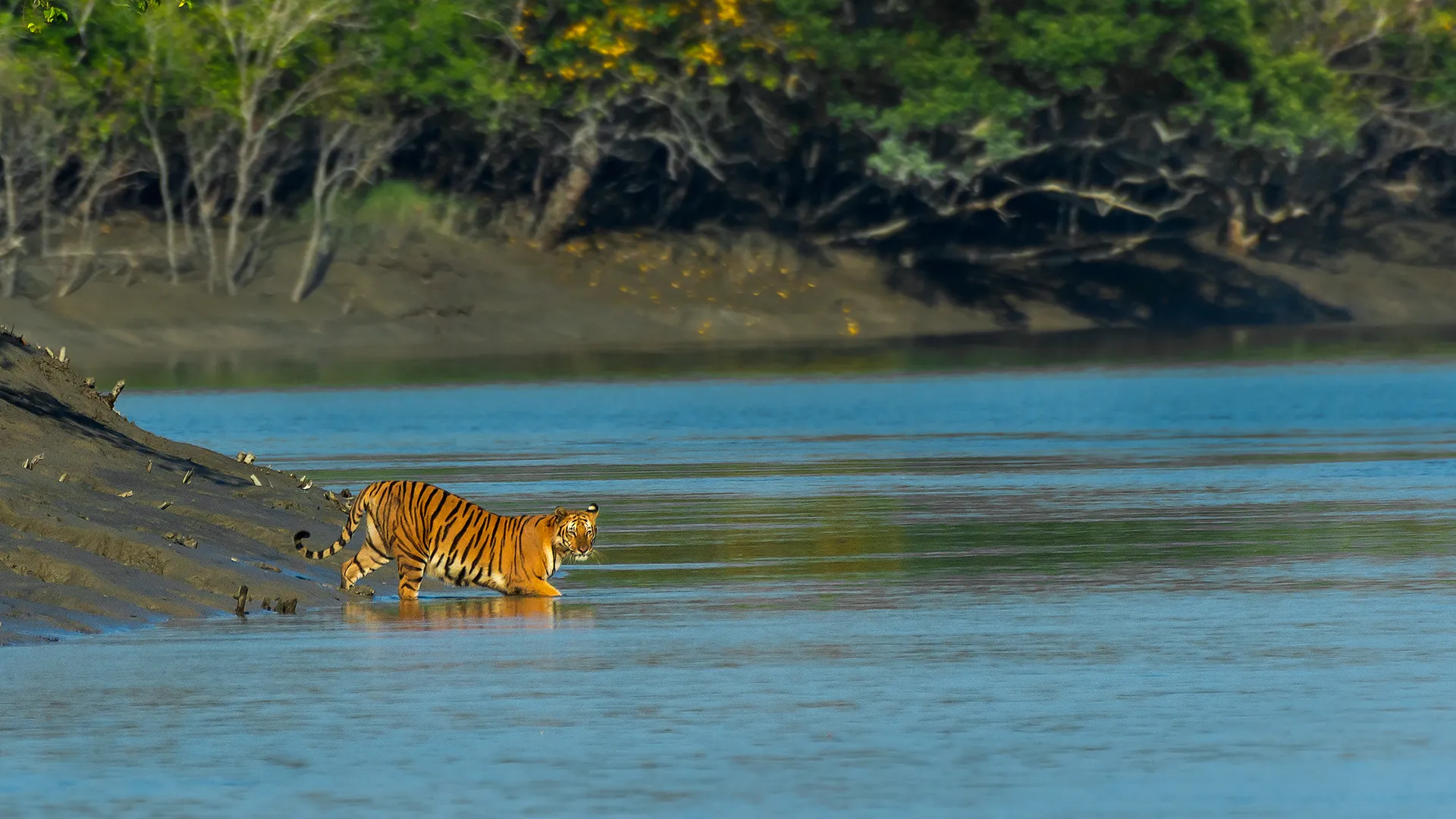
The Bengal Tiger is the Sundarbans’ most famous resident, and its presence — even unseen, even only possible — changes everything about how you move through this forest.
I never saw a tiger. Most visitors don’t. But knowing they are there — that at any given moment, somewhere in this vast green labyrinth, a Royal Bengal Tiger is moving through the same tidal channels, watching the same birds, breathing the same dense, humid air — it sharpens every sense you have.
Footprints in the mud near a creek bank. A sudden silence in the birdsong. The guide pausing, hand raised, head tilted. These moments arrive without warning and leave you with a heightened aliveness that no amount of mountain altitude has ever quite matched.
The Sundarbans has the world’s highest density of Bengal Tigers. They swim between islands, they hunt in tidal creeks, they are, in every sense, at home here in a way that we are not. The local communities — the mawalis (honey collectors) and bawalis (woodcutters) who have worked this forest for generations — carry this knowledge in their bones. They move differently here. With a particular kind of respect that isn’t fear, exactly, but something older and more nuanced.
The Birds, the Mud, the Silence
What the Sundarbans gave me, more than anything, was silence.
Not an empty silence — the forest is never quiet, exactly. Kingfishers dart between mangrove roots in flashes of electric blue. Spotted deer pick their way along the muddy banks with extraordinary delicacy, pausing to drink from the dark water, ears swivelling. Estuarine crocodiles — enormous, utterly still — sun themselves on mudflats with an air of prehistoric indifference. Olive ridley sea turtles come ashore on remote beaches to nest.
But beneath all this life runs a deep, organisational quiet. The Sundarbans is doing something vast and important — absorbing carbon, protecting coastlines, nursing the Bay of Bengal’s fisheries, sheltering species found nowhere else on earth — and it does all of this without announcement, without drama, in the methodical tidal rhythm of in and out, grow and recede, live and return to mud.
Standing in a clearing at the edge of a creek in the late afternoon, watching the light go amber through the sundari leaves, I felt — not for the first time in wild places, but more acutely than usual — the precise smallness of being human. It wasn’t an unpleasant feeling. Quite the opposite.
Hikers’ Notes
Entry: You need a permit from the Bangladesh Forest Department. All visits must be with a licensed guide.
Best season: October to March. The monsoon makes the Sundarbans spectacular but significantly harder to navigate.
Transport: Boat is everything here. Arrange your launch from Mongla or Khulna.
Wildlife sightings: Dawn and dusk are golden hours — deer, crocodiles, and birds are most active then.
The tiger: Always inform your guide of any tracks, sounds, or sightings immediately. Follow instructions without question.
Leave nothing behind. The Sundarbans absorbs many things, but plastic is not one of them.
What to carry: Binoculars, a good camera with zoom, insect repellent, water, and genuine patience. The Sundarbans doesn’t offer the clean triumph of a summit or the open exhilaration of a long beach. What it offers is rarer: the feeling of being inside something ancient and alive, something that existed long before you arrived and will continue, tide by tide, long after you leave. Walk carefully here. The forest is watching.